The difference between 304 and 316 starts with molybdenum and becomes clear in chloride environments. Which grade suits which application, based on composition, PREN, mechanical values and an environment table?
The 304 or 316 question often starts from the wrong place. People look at the material first and the environment second. It should be the other way around: if there is chloride where the part will stand for years, half of the grade selection is already done. Chloride is found in seawater, road salt, pool water, bleach and hypochlorite-based cleaners, some food brines and many chemical processes.
Without chloride, there is no visible corrosion difference between 304 and 316 in normal use. With chloride, pinhead-sized pits (pitting) can appear on 304 surfaces over time, along with staining in joint gaps (crevices). So the most honest way to describe the difference between the two grades is this: 316 leaves a wider safety margin against the localized corrosion that chloride causes.
Both grades are chromium-nickel based austenitic steels. In the 304 family, chromium is roughly between 17.5% and 19.5%. In the 316 family, chromium drops slightly, nickel rises and molybdenum is added to the composition. The ranges in the table are the mass percentages from EN 10088-2; the actual heat analysis is a point within this range and appears on the heat analysis certificate.
| Grade (AISI / EN) | C max. | Cr | Ni | Mo |
|---|---|---|---|---|
| 304 / 1.4301 | 0.07 | 17.5 - 19.5 | 8.0 - 10.5 | none |
| 304L / 1.4307 | 0.030 | 17.5 - 19.5 | 8.0 - 10.5 | none |
| 316 / 1.4401 | 0.07 | 16.5 - 18.5 | 10.0 - 13.0 | 2.0 - 2.5 |
| 316L / 1.4404 | 0.030 | 16.5 - 18.5 | 10.0 - 13.0 | 2.0 - 2.5 |
| 316Ti / 1.4571 | 0.08 | 16.5 - 18.5 | 10.5 - 13.5 | 2.0 - 2.5 |
The formula used to compare pitting resistance roughly is PREN = %Cr + 3.3 x %Mo + 16 x %N. The molybdenum coefficient of 3.3 shows why an element added in a small amount makes such a difference. We derived the values below from the EN 10088-2 ranges in the table, without taking nitrogen into account; if nitrogen is added, the value rises slightly.
| Grade | Cr range | Mo range | Calculated PREN |
|---|---|---|---|
| 430 / 1.4016 | 16.0 - 18.0 | none | approx. 16.0 - 18.0 |
| 304 / 1.4301 | 17.5 - 19.5 | none | approx. 17.5 - 19.5 |
| 316 / 1.4401, 316L / 1.4404 | 16.5 - 18.5 | 2.0 - 2.5 | approx. 23.1 - 26.8 |
Choosing 316 brings no gain in strength. In ASTM A240, the minimum yield and tensile strength values for 304 and 316 are the same; only the maximum hardness differs. In the low-carbon L grades, the minimum strength values are slightly lower. Expecting to gain strength by changing grade in a load-bearing, heavily loaded part would be a mistake; thickness and cross-section are what matter.
| Grade | Yield (MPa) | Tensile (MPa) | Elongation (%) | Hardness max. |
|---|---|---|---|---|
| 304 | 205 | 515 | 40 | 92 HRB |
| 304L | 170 | 485 | 40 | 92 HRB |
| 316 | 205 | 515 | 40 | 95 HRB |
| 316L | 170 | 485 | 40 | 95 HRB |
The table below gives a general direction. Each project is evaluated separately; temperature, chloride concentration, cleaning regime and surface condition can change the result. If you are not sure of the real conditions of the environment, it is good to discuss the grade on that basis, because changing the grade after installation means disassembly and re-fabrication.
| Environment | Typical application | General tendency |
|---|---|---|
| Indoors, dry or humid, chloride-free | Kitchen countertop, furniture, elevator cabin, interior cladding | 304 |
| Food processing, chloride-free | Tank, worktable, conveyor frame | 304 / 304L |
| Food processing, salty brine or chlorinated cleaning | Brine tank, washing line | 316 / 316L |
| Coastal and marine exposure | Exterior cladding, railing, ship and port equipment | 316 |
| Chemical, pharmaceutical, medical | Process equipment, reactor body, device housing | 316L |
| Closed environment with high chloride (for example, pool hall atmosphere) | Hanger, fitting, ventilation element | 316 may not be sufficient, should be examined separately |
If the material stays between roughly 450 and 850 °C for some time during welding, chromium carbides can precipitate at the grain boundaries in austenitic steel and the chromium in the surrounding zone is depleted. This is called sensitization and it reduces corrosion resistance. 304L and 316L reduce this risk because they limit carbon to 0.030%. 316Ti, on the other hand, is stabilized with titanium and is preferred for welded parts that operate at high temperature.
If you work with thin sheet and will not anneal after welding, the L grades are an extra layer of safety. In thick-section, heavily welded fabrication, which grade to specify is a matter for the specification. For the logic of the codes, see the grade codes article.
It cannot be told apart by the naked eye. A magnet does not separate them either, because both are austenitic and normally non-magnetic; only cold-formed areas may behave slightly magnetic. A magnet can only separate ferritic grades such as 430: if it sticks strongly, the sheet is not 304 or 316.
The way to verify is the document. An EN 10204 3.1 material certificate gives the heat number and the chemical analysis of that heat; it is matched against the label and markings on the sheet. On site, a check can also be made with molybdenum-sensitive test liquids and a portable spectrometer (PMI). The most reliable way to eliminate the risk of a mixed lot is to buy the material together with its certificate and to keep the label trace on the parts after cutting.
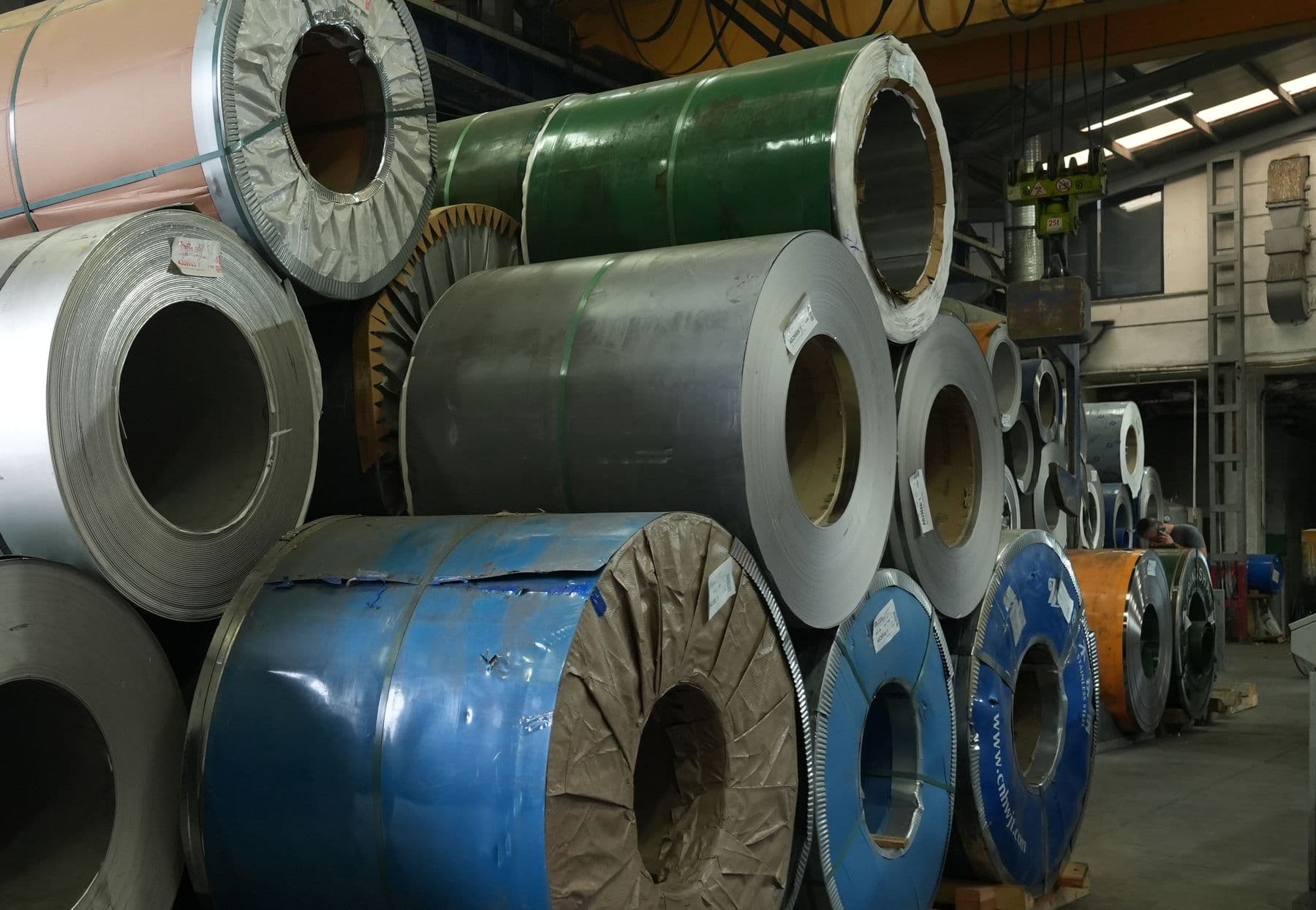
Writing only 304 or 316 in a quote request may not be enough. The more clearly you state whether it is low-carbon (L), which surface (2B, BA, No.4), which thickness and size, how many pieces and with which document, the faster and more accurate the quote can be prepared. On Güven Paslanmaz's product pages, the sheet and plate group lists 304/304L, 316/316L, 321 and 430, and the coil group lists 304/304L, 316/316L, 430 and 409; processes such as cut-to-size, slitting, laser cutting and bending are done at the same service center.
Price varies by grade, size, quantity and market; reach us through the quote form. The decision is made first by the environment, then by the surface and the way of processing.
Composition ranges are given on the basis of EN 10088-2 (stainless steels, technical delivery conditions for sheet and strip), and minimum mechanical values on the basis of ASTM A240 (chromium and chromium-nickel plate, sheet and strip for pressure vessels and general applications). Surface definitions relate to EN 10088-2 and ASTM A480, and the material certificate to EN 10204. PREN is not a product property guaranteed in the standard but an engineering comparison tool, and on its own it does not determine real behavior in the environment. What is given here is general information; what is binding for your project is your drawing and specification.
316 contains between 2% and 2.5% molybdenum and higher nickel, while 304 has no molybdenum. This difference increases pitting resistance in chloride environments. In other properties the two grades are very close.
No. It has no clear advantage in mechanical strength, machinability or corrosion resistance in chloride-free environments. 316 only provides a wider safety margin against chloride and some chemicals.
If there is no chloride-based cleaner, salty brine or constant high salt contact, 304 is a common and sufficient choice. If bleach-based cleaners are used or salty products are processed, 316 or 316L is considered.
No. Both are austenitic and normally non-magnetic. A magnet is only useful for separating ferritic grades such as 430. For 304 and 316, the definitive way is the 3.1 certificate and, if necessary, spectrometer analysis.
In welded fabrication, when no post-weld heat treatment will be done. Because carbon is limited to 0.030%, the risk of carbide precipitation around the weld is reduced. For unwelded sheet that is only folded and bent, L is not mandatory.
It is widely used in urban environments away from the coast. If there is marine exposure, road salt or a heavy industrial atmosphere, 316 is a safer choice. Washing the surface regularly also affects service life.
Very close but not the same. According to EN 10088-1, the density is 7.90 g/cm³ for 304 and 8.00 g/cm³ for 316. At the same size and thickness, 316 is about 1.3% heavier. For calculations, see the weight and size guide.

