Slitting produces narrow strip coils from coil, cut-to-length produces flat sheet from coil. The difference between the two processes, their outputs, inspection criteria, which to choose for which product and the information needed for a quote.
Both processes start from a master coil, and both use knives. The difference is the direction of the cut. In slitting, the knives cut lengthwise, in the direction the coil runs, dividing the width of the coil to produce narrower strips. In cut-to-length, the line uncoils the coil, levels the sheet and cuts it crosswise to produce sheet of the required length.
For this reason the products of the two processes cannot replace each other. You cannot use a strip coil directly as sheet, and you cannot feed a sheet to a line like a coil. The decision depends on what your machine and production line expect.
The table below puts the two processes side by side, from input and output to quality control. Details may vary by line type; this is the general framework.
| Topic | Slitting | Cut-to-length |
|---|---|---|
| Cutting direction | Lengthwise (in the direction the coil runs) | Crosswise (perpendicular to the run) |
| Input | Wide master coil | Master coil (uncoiled and leveled) |
| Output | Narrow strip coils (slit coil) | Flat sheet, of a given length |
| Line elements | Uncoiler, circular knife set, spacers, recoiler | Uncoiler, leveler unit, cutting unit, stacker |
| What determines the size | Strip width | Sheet length (and diagonal dimension) |
| Prominent inspection | Width, camber, edge burr, winding evenness | Length, diagonal dimension, flatness, camber deviation |
| Typical next step | Pipe and profile production lines, press feeding, band and spring manufacturing | Laser cutting, bending, kitchen and architectural part fabrication |
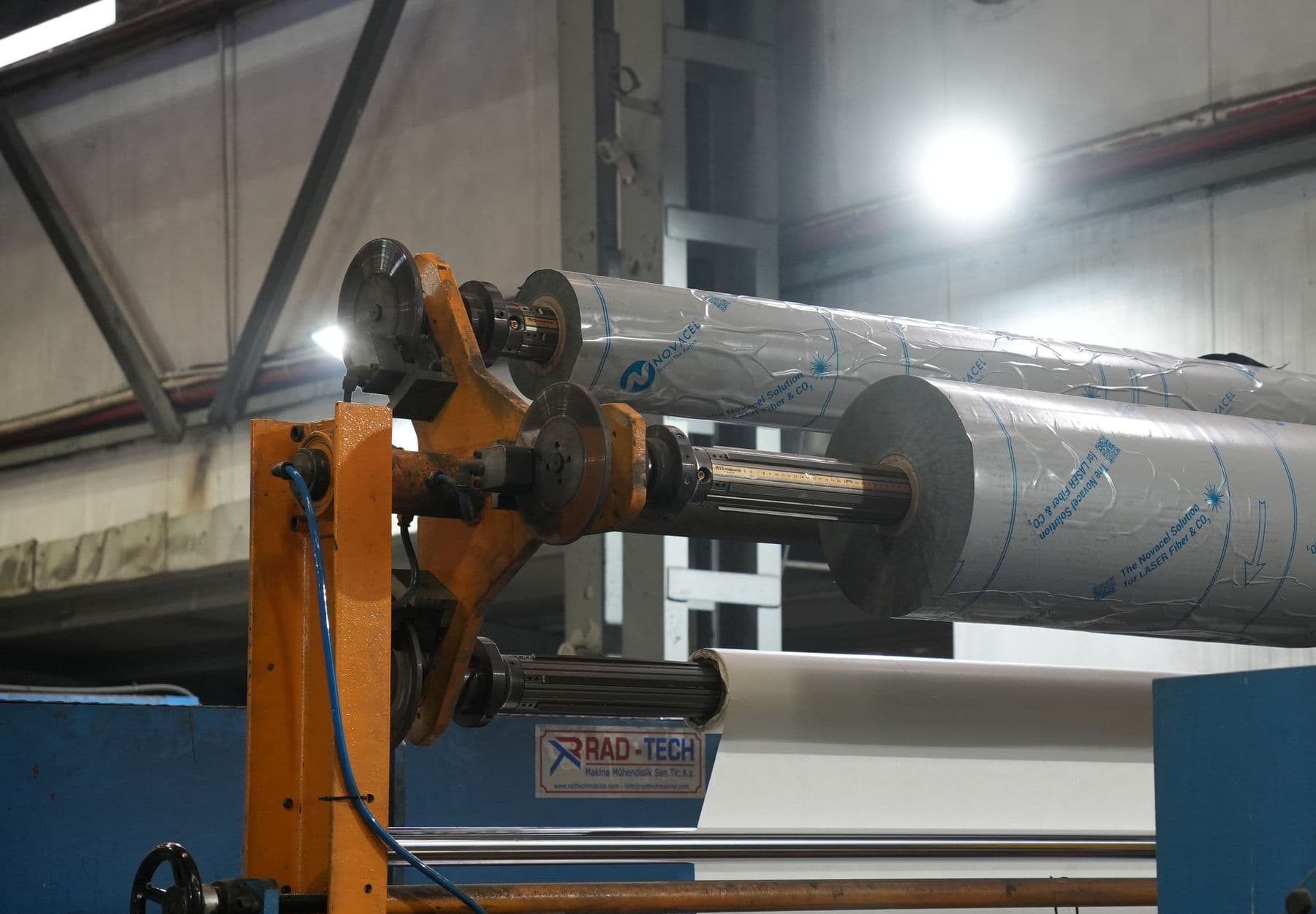
On the slitting line, the master coil is loaded on the uncoiler, and upper and lower circular knives are set up with spacers according to the desired strip widths. As the coil passes between the knives it is cut lengthwise, the edge strips (trim) are separated and each strip is wound onto a separate coil. The total of the strips produced is less than the width of the master coil by the amount of edge trim; that is why trim is also taken into account when planning strip widths.
Three topics stand out in inspection. The first is the tolerance of the strip width; for narrow strip under 600 mm and cut-length products, the limits are defined in product standards such as EN ISO 9445-1. The second is camber: if the strip has drifted sideways from a straight reference, it can run out of the guide on the feeding line. The third is edge burr; the direction and size of the burr affect the quality of the forming or pressing operation the strip will go through next. Winding evenness is also important so that the coil unwinds without problems on the next line.
On the cut-to-length line, the coil comes off the uncoiler and passes through the leveling unit, which relieves the coil set and the stress from rolling, and is then cut to a length measured by an encoder. The sheets are stacked; paper or film goes between them depending on surface sensitivity. Thanks to the leveling step, the sheet starts from a flat condition rather than from the curled state of the coil.
The main dimensions checked are length, width and the diagonal dimension. The diagonal dimension shows the squareness of the sheet and leads to errors in part nesting or on the bending table. Flatness and camber deviation are also criteria that are looked at. If you will send the sheets to laser cutting or bending, flatness affects the result directly. On the slitting line the coil is generally not leveled as much as sheet; in cut-to-length, the leveling unit is the main part of the job.
The choice is determined by how the material will be used in the next step. The table below shows typical cases and the general direction.
| Need | General choice | Why |
|---|---|---|
| Pipe or square profile production | Slitting | The forming line is fed strip of a specific width |
| Strip feeding to a press or automation line | Slitting | The line needs continuous feeding from coil |
| Narrow band, spring or thin strip application | Slitting | Narrow width is needed in coil form |
| Flat sheet for laser cutting or bending | Cut-to-length | The machine works with flat sheet |
| Ready size for kitchen and equipment fabrication | Cut-to-length | Parts are cut from sheet |
| Architectural cladding sheet | Cut-to-length | Flat, even sheet of a specific size is needed |
| Narrow and long sheet | Slitting, then cut-to-length | Width is set first, then length |
In some jobs, both are needed between the raw coil and the desired part. For example, if narrow and long sheet is wanted from a standard coil width, the width is first set by slitting, and then the strip is turned into sheet by cut-to-length. On which lines and at which thicknesses this sequence is possible depends on line capacity, so it is settled order by order in the quote process.
Many projects need only one of them. Adding an unnecessary process both scratches the material and lengthens your lead time. If you are deciding between coil, sheet, pipe and profile, the which form when article helps, and to see all the processes in order, the service center processes article does.
The identity of the material also matters after processing. In slitting, the heat number of the master coil must be carried to every strip, and in cut-to-length to every stack of sheets; the match between label and certificate (EN 10204 3.1) must be kept after processing as well. For film-coated material, how the film will behave in slitting and cutting is evaluated job by job. Writing these requests in the order note prevents surprises at the line exit.
When requesting a slitting or cut-to-length quote, if the information below is written at the start, the quote is settled in a single round. If you are starting from a master coil, state the coil information, and for strip or sheet output, state the required size.
| Information | Slitting | Cut-to-length |
|---|---|---|
| Grade and surface | 304, 316, 430; 2B, BA, No.4 | Same |
| Thickness | mm | mm |
| Base material | Coil width, coil weight, inside diameter | Coil width or existing sheet size |
| Required size | Strip widths and quantities | Sheet length and width, diagonal tolerance |
| Edge and flatness | Burr direction, edge quality | Flatness expectation |
| Packaging | Coil diameter, winding type, film | Pallet, interleaving paper, film |
| Document | Is EN 10204 3.1 required | Is EN 10204 3.1 required |
Güven Paslanmaz has both slitting and cut-to-length lines at its service center in Dudullu OSB. Because it works with product groups such as coil, sheet and plate, pipe and square profile, material and processing are gathered at a single point of contact. Which thickness and width range can be processed is settled order by order in the quote process.
Price varies by grade, size, quantity and market; reach us through the quote form. On the coil and sheet and plate product pages you can see the grade and surface options, and you can write your need in the quote form.
For dimensional tolerances, the EN ISO 9445 series (cold-rolled stainless steel, narrow strip and cut lengths, and wide strip and plate) and, for hot-rolled products, the EN ISO 9444 series are used. The material specification is EN 10088-2 and ASTM A240, and the document type is EN 10204. This article offers a general framework; line capacity, thickness and width limits and tolerances are confirmed for each order in the quote process.
Slitting is a lengthwise cut and produces narrow strip coils from a wide coil. Cut-to-length is a crosswise cut and produces flat sheets from coil. The output of the first is coil, and of the second is sheet.
The difference between the width of the master coil and the total width of the required strips becomes edge trim. Its amount is determined by the strip plan and is planned at the quote stage.
If your pipe, profile or press line works with continuous feeding, strip coil is preferred; if you will do laser cutting and bending, sheet is preferred. The input type of your machine decides it.
Coil set can leave waves and stress in the sheet. The leveling unit eliminates this. Flat sheet directly affects dimensional accuracy in laser cutting and bending.
The width and thickness limit varies by line type. The applicable range for Güven Paslanmaz is settled order by order in the quote process.
Both processes are available at the same service, but the feasibility of using them in sequence depends on thickness and size. State the need clearly in the quote form.
It is enough to write grade, thickness, size, quantity and document needs in the quote form; the details are settled in the quote process.

