What to know before having stainless steel sheet laser cut: cutting with nitrogen and air, points to watch by thickness, ISO 9013 edge quality, DXF file preparation and design rules.
In laser cutting, a high-energy beam melts the material and the assist gas blows the molten metal out of the kerf. In carbon steel, oxygen accelerates combustion and this is a natural part of the process. In stainless steel, however, an oxidized edge both spoils the appearance and locally weakens the passive chromium oxide layer. That is why nitrogen is mostly used for stainless: the gas does not take part in the cut, it only removes the molten metal and limits oxide formation on the edge.
The result is a clean cut that reduces additional edge finishing on visible and welded parts. Because edge color changes with gas type, pressure and thickness, these parameters are selected by the machine for each job; the parts decided by the customer are the material, the dimensions and the surface expectation.
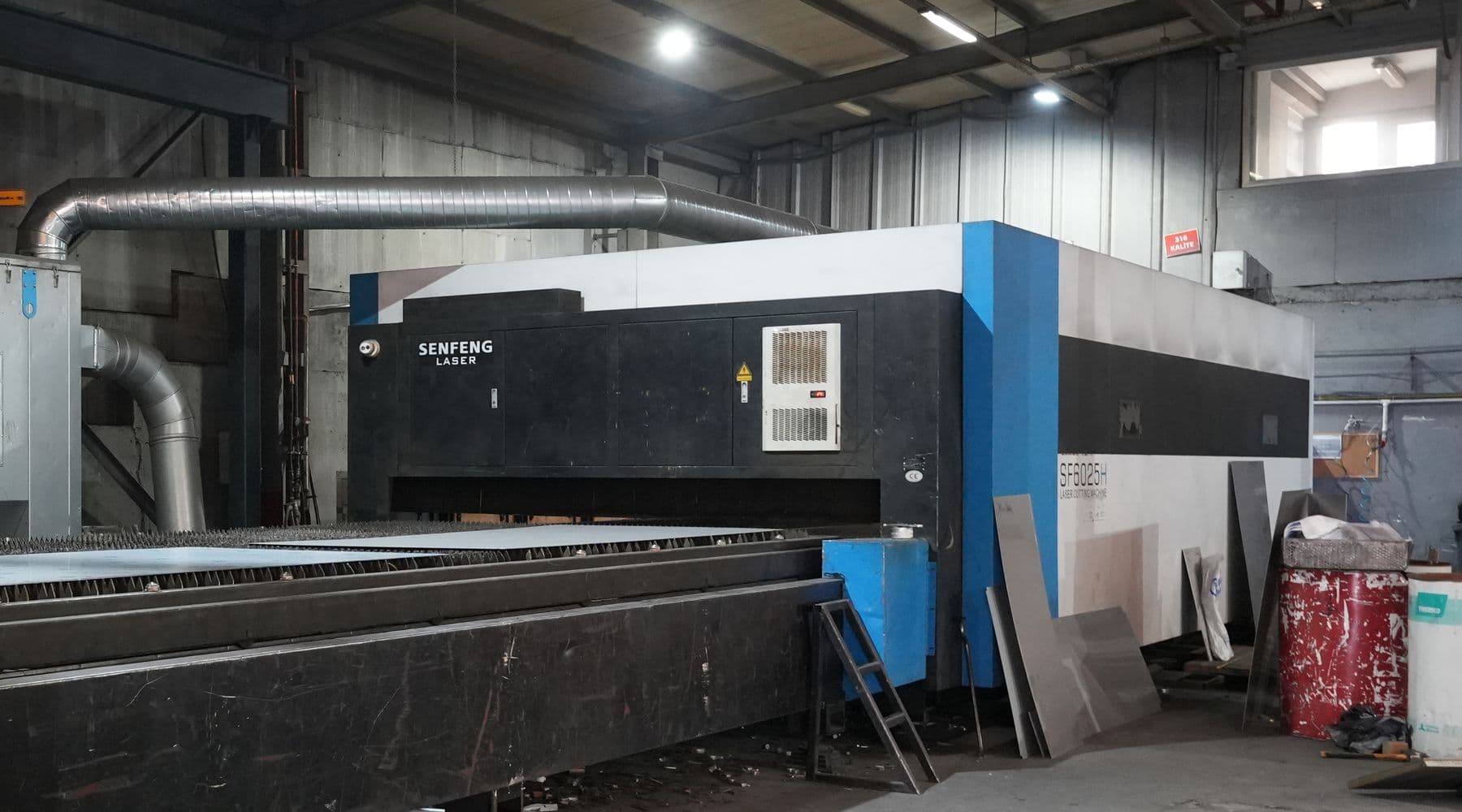
Which gas is used determines the appearance of the edge and the next process. The table below offers a general match; the real result depends on the machine, power and thickness.
| Gas | Edge appearance | When to consider |
|---|---|---|
| Nitrogen | Bright, oxide-free, light color | Visible parts, before welding, food and medical environments |
| Oxygen | Dark edge with an oxide layer | Where the edge will be ground or cleaned afterward, parts that are not visible |
| Compressed air | Light oxide, color change possible | Thin sheet, parts that are not visible and not sensitive to corrosion |
As thickness increases, cutting speed drops, heat input grows and edge quality limits tighten. With fiber laser, thicknesses from roughly 0.5 mm to 20 mm can generally be processed; the upper limit depends on laser power and differs for each machine. Güven Paslanmaz's cutting thickness limit is settled order by order in the quote process.
| Class | Prominent risk | What is done in design |
|---|---|---|
| Thin sheet | Bending and waviness from heat, surface scratching | Thin webs and long narrow parts are avoided, parts are nested tightly where possible |
| Medium thickness | Edge taper, rounding at hole corners | Critical dimensions are specified according to the edge quality class |
| Thick plate | Taper and roughness on the cut face, slow cutting | Tolerance needs are written realistically, the edge is machined afterward if necessary |
The common language of edge quality in thermal cuts is ISO 9013. The standard defines two basic measures: perpendicularity deviation of the cut face (u) and surface roughness (Rz5). Both are divided into classes from 1 to 5; 1 means the tightest and 5 the loosest class. In addition, two classes are defined for dimensional tolerances, and the tolerance varies by thickness range.
There are three things on a cut edge that can also be checked by eye: burr (hardened metal on the underside of the edge), dross (molten metal that has dripped and frozen) and heat tint. With nitrogen cutting, burr and dross generally decrease but are not eliminated. If you want operations such as deburring and edge breaking, state it in the drawing or the order.
The heat-affected zone of laser cutting tends to be narrower than with plasma and oxygen cutting, but microstructure and color can still change right next to the edge. In corrosion-sensitive uses, this narrow band is also taken into account; if necessary, the edge is cleaned afterward.
Because laser cutting turns the drawing directly into a machine program, small errors in the drawing grow in the cut. The list below shows the errors that waste the most time at the CAM stage and their correct counterparts.
| Topic | Correct | Problematic |
|---|---|---|
| Scale and unit | 1:1 scale, millimeters | Drawing at a different scale or in inches |
| Contour | Every shape a closed contour | Open lines that do not meet end to end |
| Line duplication | Each line once | Overlapping duplicate lines, double cutting |
| Text | Text converted to contours (outline) | Text left tied to a font |
| Layer | Cut, bend line and notes on separate layers | Everything on a single layer |
| Information | Grade, thickness, quantity, surface, rolling direction written separately | Only geometry sent |
A few simple choices improve both the cut quality and the later life of the part. Giving inside corners even a small radius reduces heat buildup and stress concentration at sharp corners. Thin webs left between two cuts bend from heat, so holes and protrusions should not be placed too close to each other and to the edge.
Very small holes and narrow slots make cutting harder; these lower limits depend on thickness and the machine, and giving a general number would be misleading. Before sending the drawing, review the holes and slots and ask at the quote stage about the parts you are not sure of. If bending will be done, placing a hole near the bend line causes the hole to ovalize in bending; this topic is covered separately in the bending guide.
The nesting of parts on the sheet determines scrap. Grouping different parts of the same grade and thickness on a single sheet leaves less remnant than having each cut from a separate sheet; that is why sending the drawings in a single order helps. Constraints such as grain direction, surface film or bend direction limit the nesting; if you state them at the start, it gives a good result in terms of both scrap and order time.
304, 304L, 316 and 316L behave very similarly in laser cutting. Ferritic grades such as 430 are magnetic and cutting proceeds similarly, but the edge color and processing parameters may differ. So write the grade code clearly in the quote; the machine parameters are selected together with grade and thickness. For telling grades apart, the 304 or 316 article helps.
Surface also affects cutting. Brushed (No.4) and mirror surfaces can pick up marks from contact with the table; the film on film-coated sheet can burn at the edge if the appropriate film type is not chosen. If the grain direction is visible, the direction in which the part will be nested must be stated in the drawing. For getting to know the surfaces, see the surface types article.
Heat tint (shades from yellow to blue) is a thin oxide layer on the edge and should be removed on visible or corrosion-sensitive parts. It can be removed mechanically (brushing, grinding) or chemically (acid cleaning, passivation); the relevant practices are described in standards such as ASTM A380 and ASTM A967. Which of these treatments is needed depends on where the part will be used.
Cut parts mostly go on to bending or welding. The bend allowance and bend lines must be calculated at the flat pattern stage; it is hard to correct dimensions afterward. Because CNC laser cutting, bending and grinding are done at the same service center at Güven Paslanmaz, it is possible to gather this chain into a single order. Details of the services are on the laser cutting page. Price varies by grade, size, quantity and market; reach us through the quote form.
For thermal cutting quality, ISO 9013 (thermal cutting, classification of thermal cuts, geometrical product specification and quality tolerances) is referenced, and for general dimensional tolerance, ISO 2768-1. For the material, EN 10088-2 and ASTM A240 are used, and for surface cleaning and passivation, ASTM A380 and ASTM A967. The article is for general information; cutting capacity, thickness limit and tolerance are confirmed for each order in the quote process according to the drawing and material.
A high-energy laser beam melts the material and the assist gas removes the molten metal from the kerf. For a bright, oxide-free edge in stainless steel, nitrogen gas is generally used.
DXF or DWG is preferred. The drawing must be at 1:1 scale, in millimeters, with all contours closed and lines unique. 3D formats such as STEP can also be used to produce the flat pattern.
Tolerance varies by thickness, grade and machine. Edge quality is expressed with ISO 9013 classes and general dimensional tolerance with ISO 2768-1. The required tolerance must be written in the drawing, and its feasibility is settled in the quote process.
Heat input forms a thin oxide layer (heat tint) on the edge. This effect is reduced with nitrogen cutting. On visible or corrosion-sensitive parts it is cleaned mechanically or chemically.
Both are from the austenitic family and behave very similarly in laser cutting. Still, you need to state the grade code in the quote, because machine parameters are selected according to grade and thickness.
It can be cut. However, if the film type is not suitable for cutting, burning or sticking can occur at the edge. State the film request and the surface type in the quote.
Yes, work most often continues at the same service center. If you show the bend lines on a separate layer in the cutting file, the flat pattern and allowance calculation become easier.

